
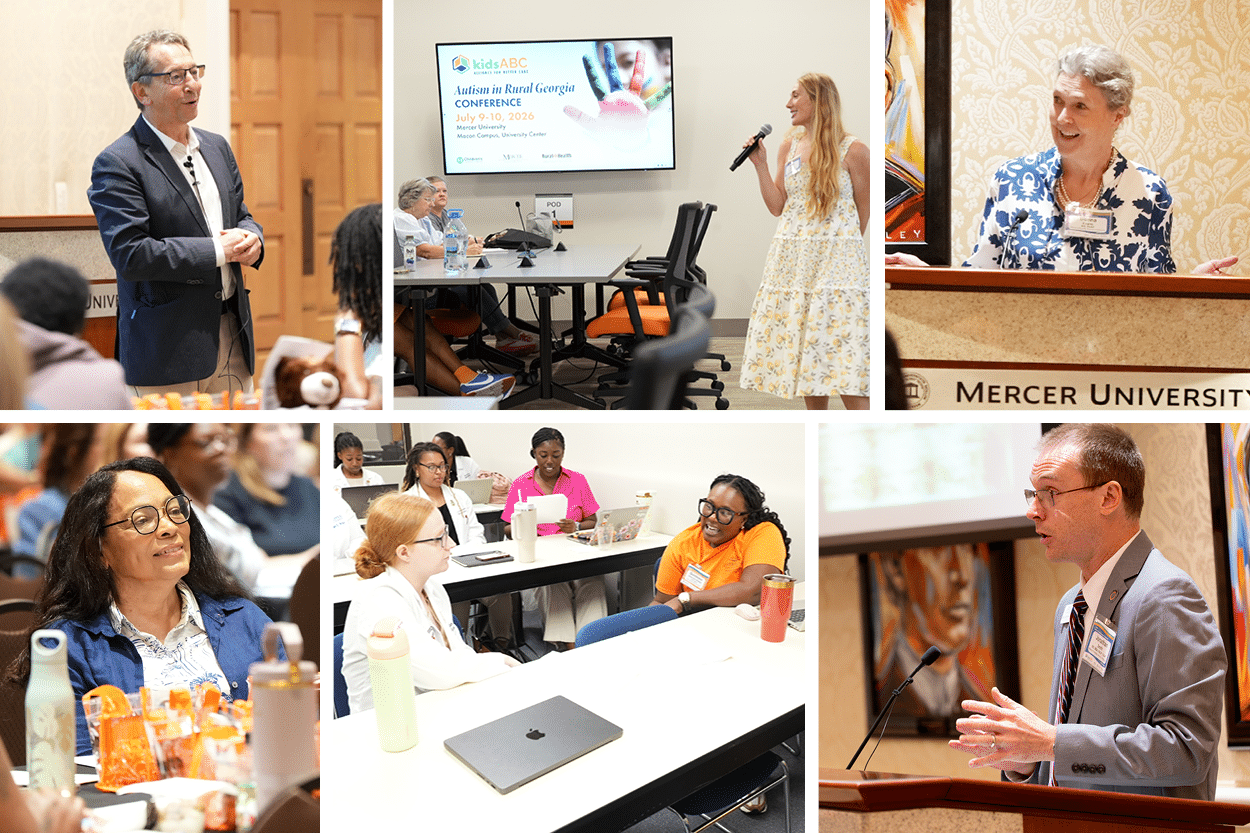
For the second year, the Mercer University School of Medicine’s Georgia Rural Health Innovation Center (GRHIC) hosted the Autism in Rural Georgia Conference on July 9-10 on Mercer University’s Macon campus. Caregivers, educators, legislators and healthcare professionals convened to gain knowledge and skills to better support and understand autistic youth in rural communities. The conference is presented through the Kids Alliance for Better Care (KidsABC), a collaboration among the School of Medicine, GRHIC and Children’s Healthcare of Atlanta.
Access to diagnostic, treatment and intervention resources for youth with autism spectrum disorder (ASD) is severely lacking in rural Georgia. Residents in these areas already face significant geographic and financial barriers to accessing primary care, and those barriers are even greater when it comes to autism-related services.
The number of providers who can diagnose and treat autistic youth is limited, leaving rural families with few options. The goal of the conference was to provide attendees with information from subject matter experts that they can take back to their communities.
On the first day of the conference, presenters shared current insights and research on topics essential to those working with autistic youth. Presentations included:
- Augmenting Access to Objective and Cost-Effective Diagnosis and Assessment of Autism in Rural Health, presented by Ami Klin, Ph.D., director of Marcus Autism Center.
- Earlipoint: Expanding Early Autism Identification in Rural Georgia, presented by Sherrie Williams, LCSW, PMP, director of the Project Management Office at Mercer University School of Medicine, and Sarah Rotschafer, Ph.D., assistant professor of biomedical sciences at Mercer University School of Medicine.
- The Integrative Care Model at the Mercer Center for IDD Care, presented by Jonathan Smith, M.D., M.B.A., FACP, FAAP, associate professor of medicine and director of the Center for IDD Care at Mercer University School of Medicine.
- Creating Trauma-Informed Neurodivergent-Affirming Educational Spaces with Intentionality, presented by Farryn Slaton-Barkley, Ph.D., founder of Rising Scholars Collective.
- The Next Chapter: Supporting Autistic Young Adults as They Transition to Adulthood, presented by Jennifer L. Wertalik, Ph.D., BCBA, associate professor in the Department of Psychology at Georgia Southern University.
- Speech/Developmental Delay and Autism Spectrum Disorder Screening and Early Detection, presented by Donna L. Evans, M.D., FAAP, professor in the Department of Pathology and Clinical Sciences at Mercer University School of Medicine.
New this year, the conference’s second day featured two learning tracks with expanded breakout sessions. Attendees could choose either the caregiver and educator track or the healthcare provider track, allowing them to select sessions tailored to their roles.
The caregiver and educator track focused on practical information and skills addressing issues affecting households with autistic youth. These hands-on sessions offered actionable tools attendees could bring back to their homes, work spaces and communities.
The healthcare provider track focused on case studies, care planning and pharmacology to help providers better serve autistic youth in their communities.
The caregiver and educator track topics:
- Supporting Autistic Youth: Strategies for Social-Emotional Challenges, Feeding Difficulties, and Emotional Regulation was presented by T. Lindsey Burrell, Ph.D., licensed clinical psychologist at Burrell Therapy and Consulting. The session provided practical strategies for supporting children with feeding and emotional regulation challenges. Attendees learned how to identify common triggers that contribute to certain behaviors and how to promote positive outcomes.
- The Behavioral Blueprint: Supporting Safe & Successful Days: Understanding and Preventing Challenging Behaviors in Autism, was led by Kayla R. Randall, assistant professor in the Department of Psychology at Georgia Southern University. Attendees participated in activities that helped them understand challenging behaviors and the factors that contribute to their development.
The healthcare provider track topics:
- Medication Management in Autism Spectrum Disorder: A Guide for Patients, Caregivers and Healthcare Professionals was presented by Shari N. Allen, Pharm.D., BCPP, professor of pharmacy practice. Attendees learned about the role medications can play in managing ASD and explored common medication classes used to address symptoms and co-occurring conditions.
- Physical Exam Components for Autism and IDD Patients was presented by Jonathan Smith, M.D., M.B.A., FACP, FAAP, associate professor of medicine and director of the Center for IDD Care at Mercer University School of Medicine. Attendees explored strategies for creating positive, accessible and patient-centered office visit experiences for autistic individuals. The session highlighted best practices for preparing patients and families for visits and adapting the clinical environment to ensure safe, effective visits.